

Prior shift, bag by bag#
Quantification lives or dies by prior-probability shift: the class
distribution \(P(y)\) changes between bags while the class-conditional
feature distribution \(P(x \mid y)\) stays the same. With
make_quantification you can dial in exactly the
prevalences you want by passing an explicit array of vectors, then watch the
clusters keep their shape while their balance shifts.
import matplotlib.pyplot as plt

from mlquantify.datasets import make_quantification

# One bag per target prevalence — same population, different class balance.
targets = [[0.9, 0.1], [0.7, 0.3], [0.5, 0.5], [0.3, 0.7], [0.1, 0.9]]
Xs, ys, prevs = make_quantification(
    prevalence=targets, batch_size=500,
    n_features=2, n_redundant=0, class_sep=1.6, random_state=0,
)

fig, axes = plt.subplots(1, 5, figsize=(15, 3.3), sharex=True, sharey=True)
for ax, X, y, p in zip(axes, Xs, ys, prevs):
    for k, color in enumerate(["#2a9d8f", "#e76f51"]):
        mask = y == k
        ax.scatter(X[mask, 0], X[mask, 1], s=8, alpha=0.6, color=color)
    ax.set_title(f"class 1 = {p[1]:.0%}")
    ax.set_xticks([])
    ax.set_yticks([])
fig.suptitle("Same clusters, shifting prevalence — prior-probability shift", y=1.02)
fig.tight_layout()
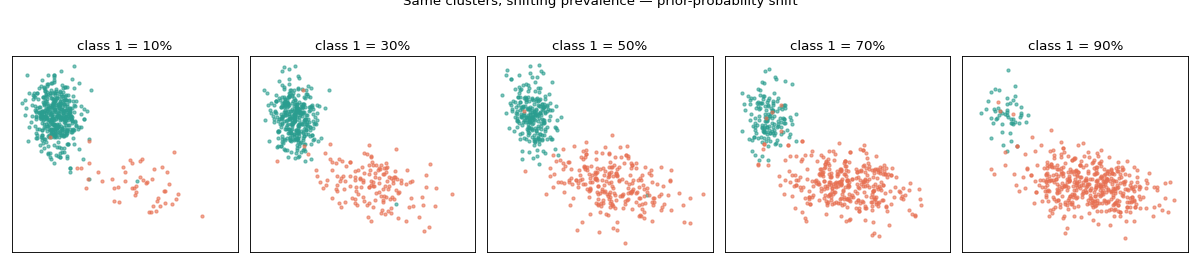
From left to right the orange class grows from 10% to 90% of the bag, yet each class always falls in the same region of feature space. That is precisely the regime quantifiers are built for — and precisely where a plain classifier’s count drifts off, because its error rates were learned at a different balance.
Pass prevalence="uniform" instead of an explicit list to draw the
prevalences randomly across the whole simplex; see
Controlling prevalence variability across bags.
See also
Benchmarking quantifiers on synthetic bags — how methods cope with this shift.
Why counting fails under prior shift — the bias prior shift induces in counting.